
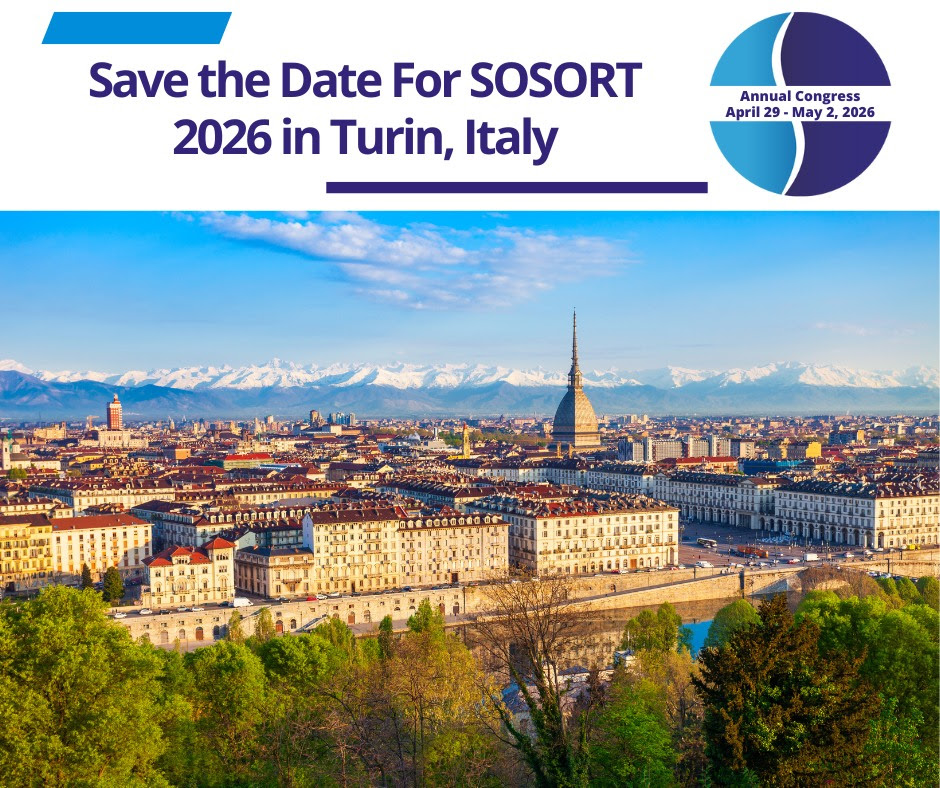

The international SOSORT 2026 Congress opened on April 29 in Turin, Italy, and will run until May 2, bringing together experts from around the world in the field of conservative treatment of scoliosis and spinal deformities.
ISICO is contributing with a significant scientific output: 23 studies delivered as oral presentations a
Exercise adherence: understanding motivation to personalise care
A Rasch-Validated Questionnaire for Evaluating Adherence Predisposition to Scoliosis Specific Exercises in Adolescents with Idiopathic Scoliosis: Preliminary Results
Vanossi M., Ferrario I., Leonelli B., Negrini S., Negrini A.
This study, presented as an oral presentation, introduces a Rasch-validated questionnaire designed to assess adolescents’ predisposition to adhere to scoliosis-specific exercises.
Findings show that adherence is multidimensional, driven by:
- intrinsic motivation,
- extrinsic motivation.
These components interact and influence patient behaviour differently, providing a foundation for more personalised and effective treatment strategies.
Video comment by Irene Ferrario
Brace quality: a checklist to standardise the brace check process
The “Brace-Check List”: A New Tool for Scoliosis Brace Quality Control
Febbo F., Zaina F., Lusini M., Zonta A., Ferrario I., Negrini S., ISICO physicians and I-SHAPE team
This study (an oral presentation at the conference) presents a structured checklist, developed through a consensus process, to improve the quality of brace evaluation.
It addresses four key domains:
- brace fitting,
- tolerability,
- three-dimensional balance,
- corrective effectiveness.
The goal is to make the brace check more systematic and reliable, ultimately improving both treatment outcomes and adherence.
Video comment by Francesca Febbo
Brace adherence: perspectives from patients, families, and professionals
Bracing for Success: Comparison of Patient, Family, and Professional Perspectives on Barriers and Facilitators from 3414 Messages in a Scoliosis Blog (poster)
Rebagliati G., Negrini A., Colombo M., Negrini F., Ferrario I., Negrini A., Zaina F., Negrini S.
Presented as a poster, this study analyses over 3,400 contributions to identify barriers and facilitators to brace adherence.
Key differences emerge across groups:
- patients mainly report emotional impact and physical discomfort,
- parents highlight informational needs,
- professionals focus more on clinical aspects.
Facilitators include clinical support, effective communication, and perceived treatment results, highlighting the importance of a comprehensive, multidisciplinary approach.
Video comment by Giulia Rebagliati
Exercises and gender: minimal differences, beyond stereotypes
Gender differences in self-reported adherence to scoliosis-specific exercises: a cross-sectional study of 2,214 patients with adolescent idiopathic scoliosis
Romano M.
This study, presented as an oral presentation, investigates gender differences in exercise adherence in over 2,200 adolescents.
Males reported slightly higher exercise time than females; however, the difference is:
- statistically significant,
- but clinically negligible.
These findings challenge common assumptions and support the need for individualised approaches rather than gender-based expectations.
Video comment by Michele Romano
Ongoing updates
In the next updates, we will share more studies, along with insights and reflections emerging from the congress. The results of the SOSORT Award winners are also expected in the coming days.
